Here you will find the latest news on the development of OrcaFlex. Alongside our LinkedIn page, it is a valuable source of information about what we are up to!
We have just released a minor upgrade to OrcaFlex, version 11.5b. Version 11.5b fixes a single bug in 11.5a. If OrcaFlex 11.5a cannot find a license at startup, it reports an access violation error instead of an informative error message.
We recommend that all users of 11.5a upgrade to 11.5b.
To upgrade to OrcaFlex 11.5b from any previous version, download the install program from your company’s Orcina software download page. A link to this page was sent to your software administration contact when we released 11.5a. If you do not have access to this page, please contact us.
We are very pleased to announce the release of OrcaFlex version 11.5. The software was finalised and built on 12th December. All clients with up-to-date MUS contracts will receive, in the next few days, an e-mail with instructions on how to download and install the new version.
Update: These e-mails were all sent on 13th December.
Version 11.5 introduces much new functionality, including:
These are the most significant developments, in our opinion. As always there are more enhancements that are not listed here. All new features are fully documented in the what’s new topics:
A new diffraction example is now available on our website: L04 Sectional bodies. The example demonstrates how sectional bodies, introduced in v11.4, can be used to enhance the multibody analysis capabilities of OrcaWave & OrcaFlex.
Prior to v11.4, OrcaWave & OrcaFlex were capable of undertaking multibody analysis, provided that each body could be considered closed. This capability is useful when modelling two or more independent structures in close proximity. Furthermore multibody analysis can be used to analyse the loads within a single structure, provided that structure can be represented by a collection of distinct meshed bodies (see Example L03).
In v11.4 onwards, a new type of body has been introduced that we refer to as a sectional body. Users are able to construct structures from multiple sectional bodies. Each sectional body references an open ended mesh. When considered as a group, the sectional body meshes unite to represent the closed hull.
The example focusses on a semi-sub platform that closely resembles the VolturnUS platform, as modelled in example K03. The platform is represented using a system of seven sectional bodies. We show how sectional multibody analysis can be used to evaluate the distributed loads within a structure. Furthermore we demonstrate how this approach can be used in tandem with OrcaFlex line and constraint objects to model a degree of flexibility in the platform. We anticipate that the results reported by OrcaFlex could be used to inform a targeted analysis conducted with specialised structural analysis software.
We hope that this example is informative and helps to expand your knowledge of the diffraction capabilities within our software.
Semi-sub platform modelled as a sectional multibody system
On the 7th November 2024 a staff member’s email account was compromised and unfortunately this has resulted in phishing emails being sent to some of our customers. We were aware of the breach within minutes of it occurring and were able to quickly secure the account to prevent further malicious actions. We have investigated activity on this account and are sure this was limited to the online email account and no more.
The email sent had the subject line Emma Johnston shared “Orcina Ltd Project Report” with you, and the email contained an attachment. In many cases this will have been quarantined by your email system but if you see this email in your inbox then please delete it, do not click on any links within the email or attempt to open the attachment.
We apologize for any inconvenience and confusion this may have caused. It is embarrassing for us that this has occurred as we take security very seriously. We are consequently reviewing our security configuration.
We have just released a minor upgrade to OrcaFlex, version 11.4d. Version 11.4d fixes a number of bugs. Full details of the changes are described in the documentation:
We recommend that all users of 11.4 upgrade to 11.4d.
To upgrade to OrcaFlex 11.4d from any previous version, download the install program from your company’s Orcina software download page. A link to this page was sent to your software administration contact when we released 11.4a. If you do not have access to this page, please contact us.
The example illustrates how to access the OrcaFlex interface to SHEAR7, using the steel catenary riser system considered in the A05 Catenary with spar example.
SHEAR7 is a third-party program, distributed by AMOG, which performs frequency domain VIV analysis for the purpose of estimating fatigue and/or drag amplification due to VIV. A separate licence is required to run SHEAR7 through the interface. However, the example results can be viewed without a SHEAR7 licence.
The accompanying PDF document provides detail on how to access the interface, what input data are required and how to access the VIV results. However, the example does not address how to choose appropriate values for the SHEAR7 data inputs, as these relate to SHEAR7 itself, rather than the OrcaFlex interface.
We hope that the example provides a useful guide to the SHEAR7 interface, allowing it to be used effectively.
A new example, K06 FPV array, is now available on our website. This example demonstrates one method of modelling a floating photovoltaic (FPV) array system in OrcaFlex and can be found in the K Renewables section of the OrcaFlex examples webpage.
The array is made up multiple modular rafts which are connected using indirect constraints with double-sided connections. The array model was built by duplicating a template model which represents a single raft module. The model building process was automated using the OrcaFlex programming interface (OrcFxAPI) and this is demonstrated in the Python script supplied alongside this example.
The accompanying PDF document goes into further detail on the model building process, setting data and interpreting results. It also includes a discussion on indeterminate systems and how they can sometimes arise.
We hope that this example is informative and can provide some useful insights into both new and existing OrcaFlex features that can help model floating array systems.
OrcaFlex model of a floating photovoltaic (FPV) array.
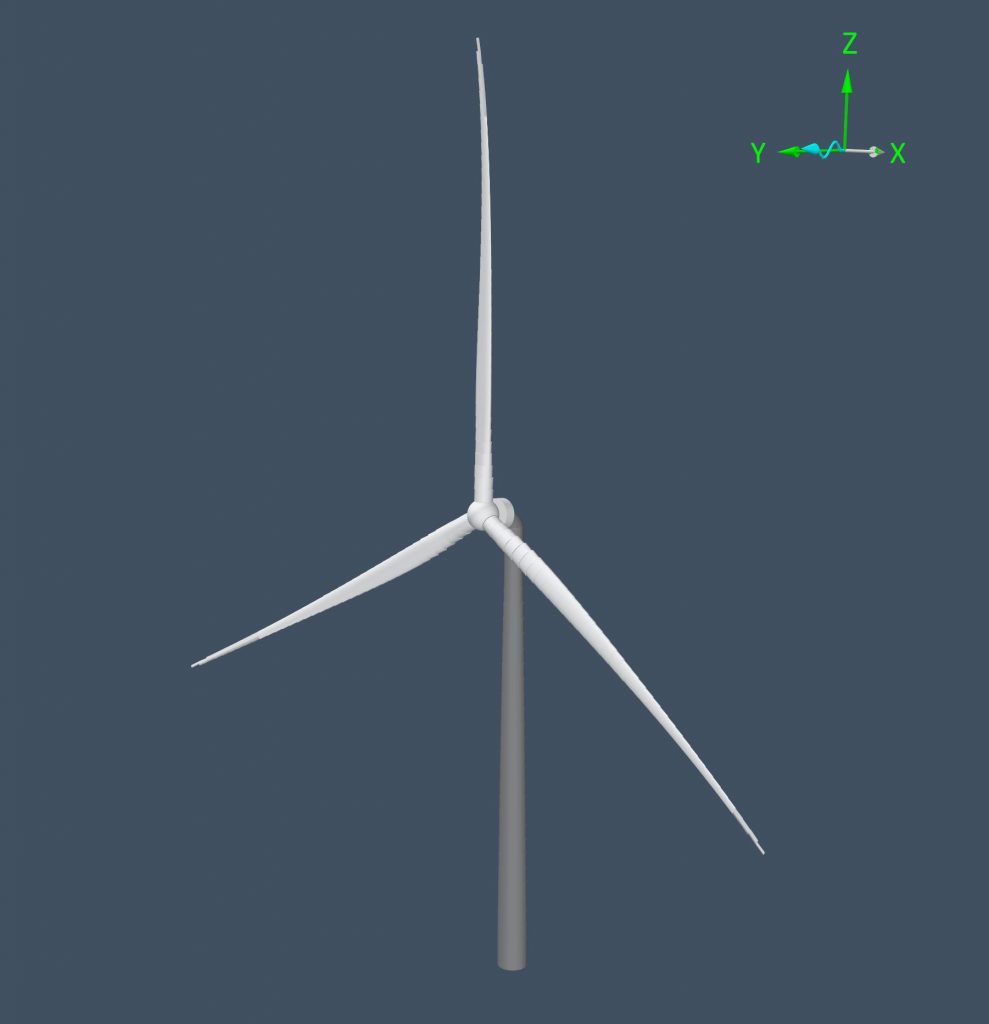
We have recently put together a validation study which compares the aeroelastic response of the IEA 22 MW reference wind turbine (RWT) calculated by OrcaFlex, versus OpenFAST (running BeamDyn).
A report summarising a full comparison of results can be downloaded from the validation page of the Orcina website. The study considers the structural dynamics of the turbine blade oscillating freely under gravity and the aeroelastic response of the rotor-nacelle assembly (RNA) & tower to steady, stepped, skewed & turbulent wind.
Included with the report is the OrcaFlex model we have used to support the validation study. The model includes the rotor, nacelle and tower only i.e. no fixed / floating foundation has been considered as part of this study. The data used as input to this model have been gathered from version 1.0.1 of the the windIO dataset, made available through the IEA-22-280-RWT GitHub repository. The windIO ontology contains the majority of data required to specify an OrcaFlex turbine model. Any absent data have been sourced from the available OpenFAST and HAWC2 datasets. Further details about this can be found in Section 2.1 of the validation report.
Also included with the model is version 2.9.0 of NREL’s Reference Open Source Controller (ROSCO), complete with the necessary input files distributed as part of the ‘IEA-22-280-RWT-Monopile’ dataset.
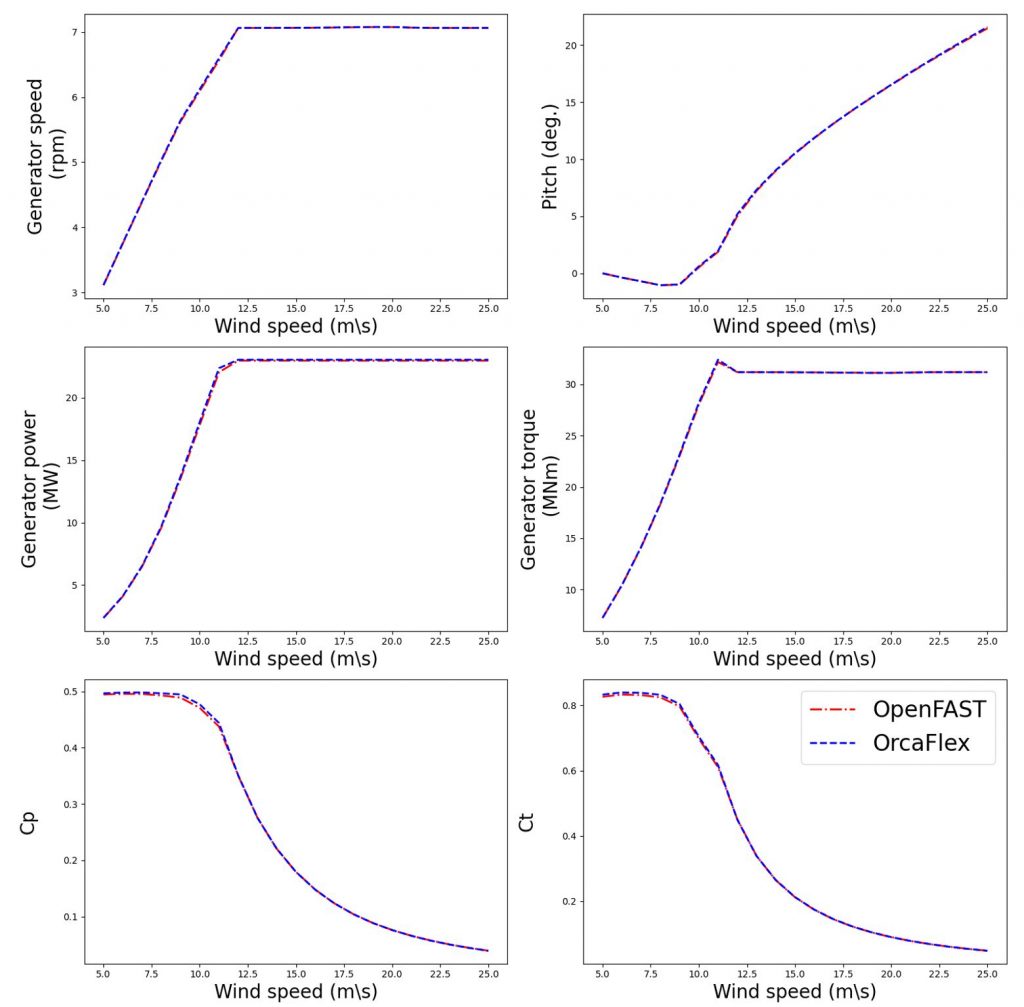
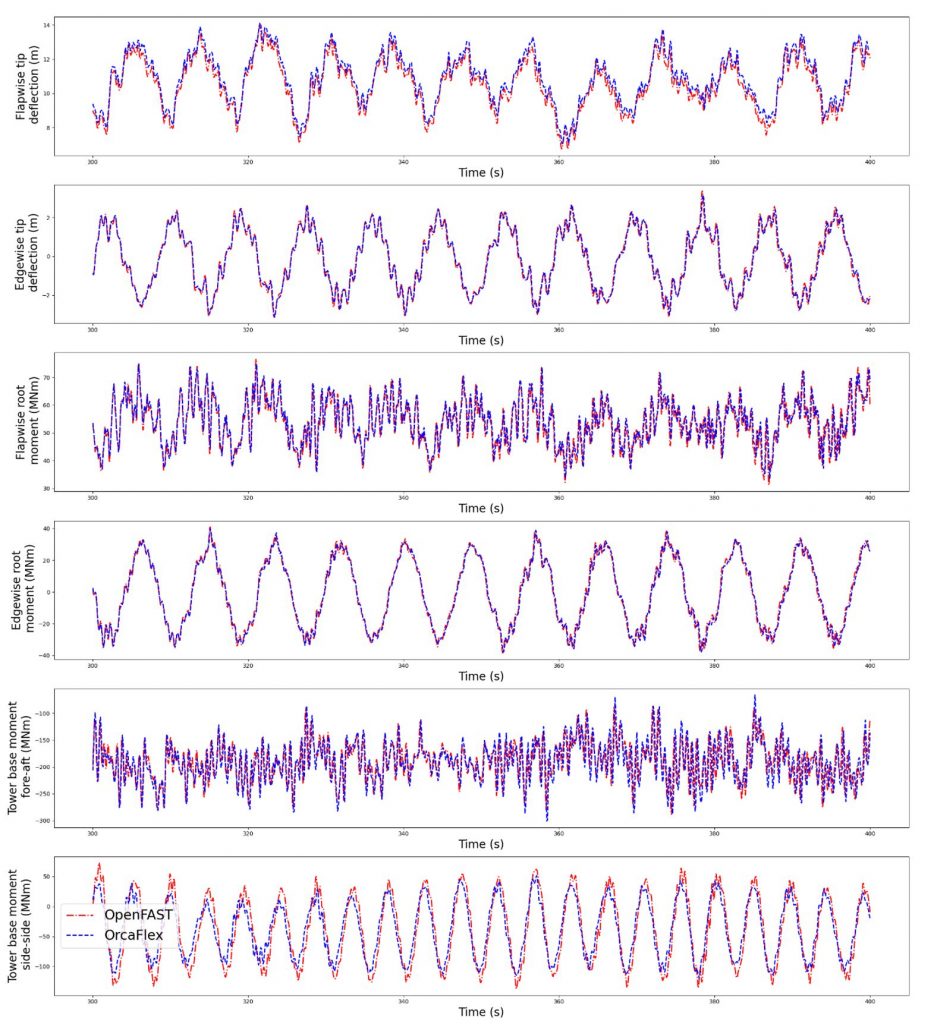
Overall, we have found the results to be in very close agreement, supporting both the validity of the OrcaFlex RWT model and consistency across the two aeroelastic codes. Included below are some select results from the validation report.
We hope this resource will be helpful to anyone modelling wind turbines in OrcaFlex. We always welcome any questions or feedback, so please do contact us for any further enquiries.
OrcaFlex model of the IEA 22 MW reference wind turbineComparison of the aerodynamic and operational steady-state response of the 22 MW rotorComparison of the blade and tower response to turbulent wind
We have just released a minor upgrade to OrcaFlex, version 11.4c. Version 11.4c fixes a number of bugs. Full details of the changes are described in the documentation:
We recommend that all users of 11.4 upgrade to 11.4c.
To upgrade to OrcaFlex 11.4c from any previous version, download the install program from your company’s Orcina software download page. A link to this page was sent to your software administration contact when we released 11.4a. If you do not have access to this page, please contact us.