
Orcina news

Here you will find the latest news on the development of OrcaFlex. Alongside our LinkedIn page, it is a valuable source of information about what we are up to!

Update to K06 FPV array example

We have recently made some updates to the K06 floating solar array example, which is available for download on the website here OrcaFlex Examples: Renewables.

This example now models the floating modules as being fully rigid structures consisting of 6D buoy objects (instead of a combination of buoys, lines and constraints). The double-sided constraints in this example now use the stiffness and damping specified by 6×6 matrices feature introduced in version 11.6. This example demonstrates a method that can be used in similar floating solar applications that can improve dynamic convergence and allow meaningful connection loads to be extracted. This is explained in the accompanying PDF document.

Additionally:

  • A shaded drawing .obj file is now used for the solar panel 6D buoys.
  • A custom replay specification file and associated models are included with the example.

We hope that you will find the latest updates helpful. We always welcome any questions or feedback, so please do contact us for any further enquiries.
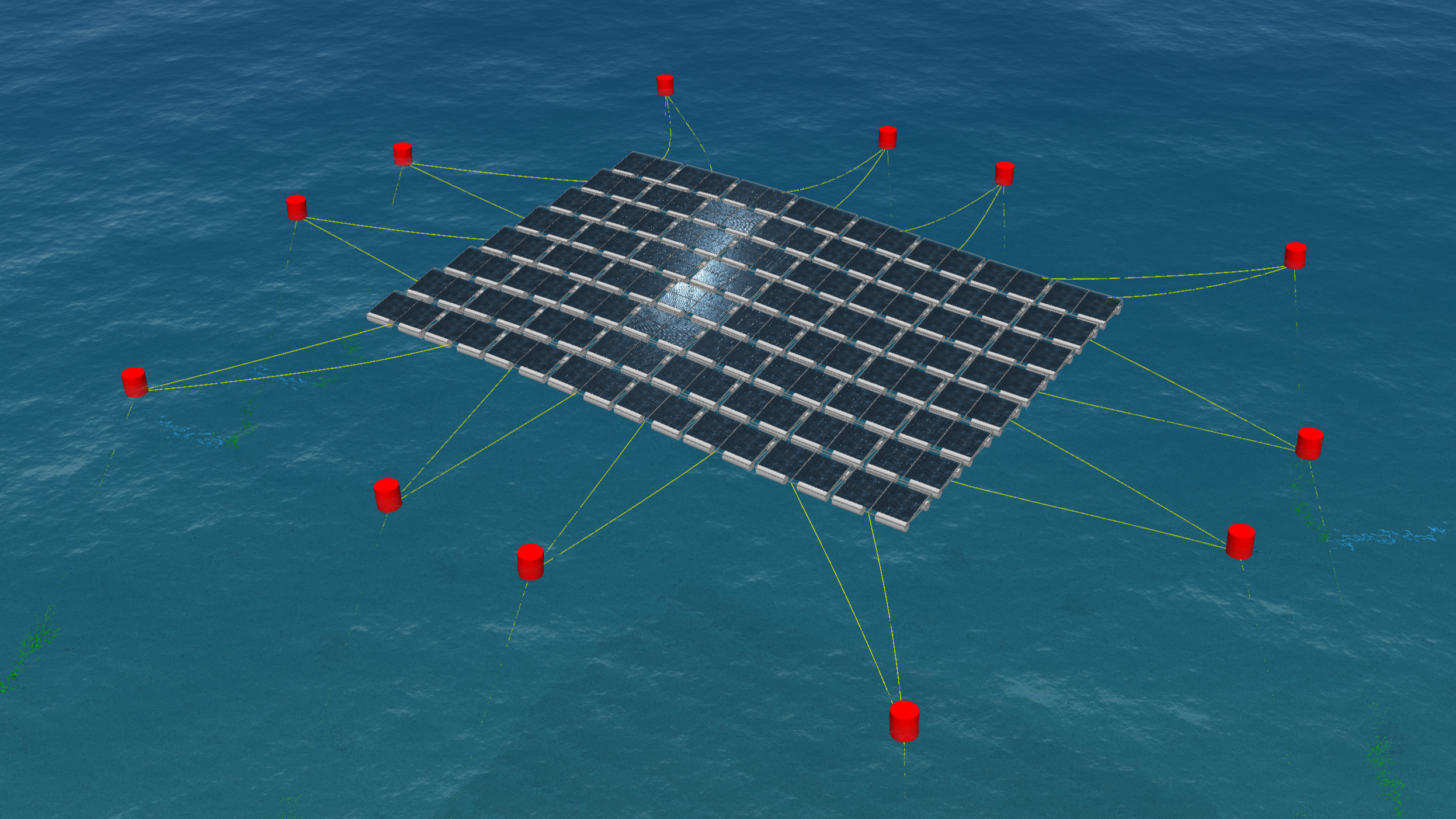
OrcaFlex model of a floating photovoltaic (FPV) array

New floating photovoltaic array example

A new example, K06 FPV array, is now available on our website. This example demonstrates one method of modelling a floating photovoltaic (FPV) array system in OrcaFlex and can be found in the K Renewables section of the OrcaFlex examples webpage.

The array is made up multiple modular rafts which are connected using indirect constraints with double-sided connections. The array model was built by duplicating a template model which represents a single raft module. The model building process was automated using the OrcaFlex programming interface (OrcFxAPI) and this is demonstrated in the Python script supplied alongside this example.

The accompanying PDF document goes into further detail on the model building process, setting data and interpreting results. It also includes a discussion on indeterminate systems and how they can sometimes arise.

We hope that this example is informative and can provide some useful insights into both new and existing OrcaFlex features that can help model floating array systems.

OrcaFlex model of a floating array with 64 rectangular rafts in the array and 12 buoys in the mooring system.
OrcaFlex model of a floating photovoltaic (FPV) array.