Orcina news

Here you will find the latest news on the development of OrcaFlex. Alongside our LinkedIn page, it is a valuable source of information about what we are up to!

OrcaFlex 9.4 released

A whole year has now passed since we released OrcaFlex 9.3 which means that it is time for the release of OrcaFlex 9.4! As always it takes time to produce and despatch installation CDs but clients with up-to-date MUS contracts can expect to receive the software some time around the end of August.

The major enhancements in version 9.4 fall into the following categories:

  • Improved performance of the OrcaFlex post-processing spreadsheet.
  • Enhancements to modal analysis: whole system analysis, better performance.
  • Enhancements to fatigue analysis: mean stress, mooring fatigue using T-N curves, SHEAR7 fatigue.
  • Line contents modelling: free-flooding, slug flow, spatial and temporal variation of contents.
  • Vessel data import enhancements for generic text files.
  • Better handling of vessel RAO data which omits zero period response.
  • Improved modelling of solid contact at edges and corners.
  • Line floats wizard now supports Reynolds number dependent drag.
Continue reading “OrcaFlex 9.4 released”

OrcaFlex 9.3 released

As now seems to be traditional, here at Orcina we have spent the summer months working very hard to complete a major upgrade to OrcaFlex. The result is OrcaFlex 9.3 which was formally released early in August. We have just despatched the final upgrade CD and so all customers with up-to-date MUS contracts will have the software very soon, if not already.

I should also point out that we have released a minor upgrade (version 9.3b) which fixes some bugs that have come to light in version 9.3a (the version included on the upgrade CD). As usual a patch to upgrade from 9.3a to 9.3b is available for download.

The major enhancements in version 9.3 fall into the following categories:

  • Extreme value statistics post-processing of results variables.
  • Text data file (in addition to existing binary data file).
  • Enhanced interface to SHEAR7.
  • Static state simulation files.
  • Non-linear material properties for elastomeric bend stiffeners.
  • API 2RD stress check.
  • Coatings and linings for homogeneous pipe.
  • Roll damping for vessels.
  • Modal analysis improvements.
  • Performance improvements.

Continue reading “OrcaFlex 9.3 released”

OrcaFlex post-processing spreadsheet

We have recently become aware that the version of the OrcaFlex spreadsheet released with OrcaFlex 9.2 has some performance problems. These do not always manifest themselves and we have not seen the problems ourselves. Fortunately a small number of clients have raised the issue and we have been able, with help from those clients, to diagnose the problem. OrcaFlex 9.2f fixes this issue.

While we are on the subject of the post-processing spreadsheet it seems appropriate to announce some of the changes we are making for 9.3. As you are probably aware the post-processing spreadsheet is implemented using Excel VBA macros. These link, in turn, to the OrcaFlex code through our OrcFxAPI DLL.

VBA macros have many strengths but we have become somewhat constrained by their limitations. For 9.3 we will be moving all the code into the OrcFxAPI DLL. One immediate benefit of this is that our spreadsheet template will no longer contain any macros and so will not be subject to Excel’s macro security dialogs.

For 9.3 we are planning to keep the user-interface to the spreadsheet identical to previous versions. We are, however, planning one very significant change to the implementation. All previous versions processed instructions serially and made no use of the multi-core processors that are now commonplace. It is not possible to perform calculations in parallel with VBA macros. Moving the processing code into the OrcFxAPI DLL will enable us to process load case results extractions in parallel. This should significantly reduce the time taken to post-process results.

This development is currently partially complete and we have not yet implemented the multi-threading of the results extraction. I look forward to being able to write about the performance of the multi-threading aspect of this work when it is complete. Hopefully I’ll be able to announce big improvements in extraction times.

Non-linear Seabed Soil Model Released

We have now released the non-linear seabed soil model in OrcaFlex 9.2e. The model has been developed by Professor Mark Randolph (Centre for Offshore Foundation Systems, University of Western Australia), a recognised expert in this field, and we have been working with Mark to implement the model in OrcaFlex.

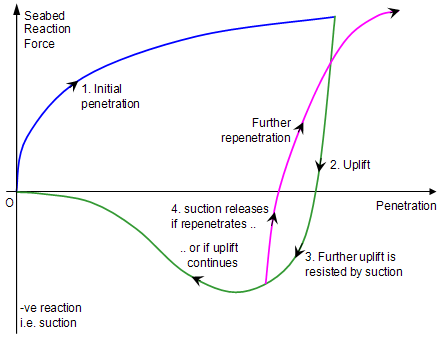
The model is for modelling the seabed resistance for catenary pipeline contact. It takes as input the line diameter and the seabed soil geotechnical properties (undrained shear strength at the mudline, shear strength gradient with depth, soil saturated density). It then calculates the seabed reaction force on each line element as a function of the penetration, allowing for non-linear penetration resistance, hysteretic effects due to uplift and repenetration, and non-linear suction forces.

Some of the model characteristics are illustrated in the following diagram. For comparison, the standard OrcaFlex linear seabed model would give just a straight line seabed reaction curve in the diagram.


Non-linear Soil Model

OrcaFlex 9.2 released

We are very pleased to announce the release of OrcaFlex version 9.2a. We are now starting the process of producing the installation CDs and customers with up to date MUS contracts should receive the upgrade in the middle of September.

There are a great many enhancements to the software which we described in the previous blog post. The only significant change in the software from that post is that the non-linear soil model is not included in 9.2a. We have not had sufficient time to perform the testing and validation of this development to a level sufficient for release. We are continuing to work on this and hope to include the non-linear soil model in a minor 9.2 update sometime later this year.

OrcaFlex 9.2 new features

It’s been a long time since our last article and we’ve all been very consumed with work for OrcaFlex 9.2. We are nearly ready to release this major upgrade and are now in a position to announce the new features which it will introduce. The major enhancements fall into the following categories:

  • Performance
  • Bend Stiffener and Stress Joint modelling
  • Multi-threaded batch processing
  • Fatigue post-processing enhancements
  • Non-linear seabed
  • Wake deficit / interference modelling
  • Wave spreading
  • 6 DOF Vessel QTFs
  • Python interface to OrcFxAPI

Continue reading “OrcaFlex 9.2 new features”

OrcaFlex 9.1 released, the fastest OrcaFlex yet!

As I’m quite sure every OrcaFlex user knows by now, OrcaFlex 9.0 introduced an implicit time domain solver in addition to the existing explicit solver. This change led to huge improvements in run times and thus prompted us to award the release ‘major upgrade status’ and promote it from version 8 to version 9!

In August 2007 we released OrcaFlex 9.1, which introduced many further improvements to the implicit solver — version 9.1 is now significantly faster than 9.0. The purpose of this blog post is to discuss some of the improvements in version 9.1, present a runtime comparison with Flexcom, and to discuss some future developments we plan to make OrcaFlex even faster still.

Continue reading “OrcaFlex 9.1 released, the fastest OrcaFlex yet!”

Keyboard shortcuts for rotation

One of the changes we made in OrcaFlex 9.1 was a re-mapping of keyboard shortcuts. Mostly this was motivated by a desire to map CTRL+S to File | Save and CTRL+O to File | Open.

To make room for these changes we had to rearrange a number of other shortcuts. In particular the shortcuts to rotate the 3D View were changed to CTRL+ALT+ ← → ↑ ↓. Shortly after releasing version 9.1 we began to hear reports from some users that their laptop screen would suddenly be displayed upside down, or on its side, after using one of these shortcuts.

After a little detective work we have traced the issue to a piece of Intel software that is stealing these keyboard shortcuts before they reach OrcaFlex. The solution is as follows:

  1. Open the Control Panel and make sure it uses Classic View.
  2. Double click the Intel GMA Driver for mobile icon.
  3. Select the Hot Keys page.
  4. Deselect the “Enable Hot Keys” option.

This will fix the problem for Intel graphics cards, but there may be similar problems for cards from other manufacturers, or even for different Intel cards. I’m guessing that similar solutions will be available and that the steps described above should help you solve such problems.

Possible changes to modelling of hollow spar buoys

This article proposes some possible changes that we are considering, to the way OrcaFlex treats the water inside a hollow spar buoy, i.e. where a spar buoy object in an OrcaFlex model has a non-zero ID specified for one or more of its cylinders. We would welcome feedback from OrcaFlex users (and potential users) on whether the change that we are considering would be a useful.

The existing OrcaFlex treatment of hollow spar buoys is aimed at modelling hollow axi-symmetric structures that flood and drain very freely in the axial direction. But it is less suitable for hollow objects that do not flood and drain so easily, and these proposals aim to address this.

Continue reading “Possible changes to modelling of hollow spar buoys”

Whole System Statics

Many of the software support questions we receive concern statics convergence. Before the release of OrcaFlex 9.0 we would regularly employ a host of methods to deal with stubborn cases. The problem cases would usually involve 6D Buoys.

OrcaFlex 9.0 introduced a new statics method called Whole System Statics (WSS) which provides a great leap forward in terms of robustness and speed of convergence. Practically all support queries relating to statics convergence are now solved by switching to use WSS. So what makes WSS so much better than the old method?
Continue reading “Whole System Statics”