OrcaFlex Example Simulation Files

Below are example OrcaFlex simulation files that can be opened and viewed with the demonstration version of OrcaFlex. Details about each example simulation are given in the OrcaFlex help file, which is installed when you install the demonstration version – see Examples on the OrcaFlex Help menu.

The list of examples is quite large and so we have grouped together related examples. You can use the links below to jump straight to a particular group.

A - Riser Systems - simple models
B - Riser Systems - more complex
C - Steel Catenary Risers
D - Tensioned Risers, TLPs and SPARs
E - Mooring Systems
F - Buoy Systems
G - Installation
H - Offloading Systems
I - Towed Arrays
K - Line-on-line Contact
M - VIV

A - Riser Systems - simple models

A01 Catenary Riser.sim (1.1 MB)

This is the simplest riser configuration. Two lines descend from a vessel to the seabed. Although close to vertical when they leave the vessel, they are parallel with the seabed at touchdown.

The example also shows OrcaFlex's ability to model a sloped seabed, non-linear axial stiffness and variation of drag coefficient with Reynolds Number.

A01 Catenary Riser.sim

A02 Lazy Wave Riser.sim (1.1 MB)

A lazy wave formation is similar to a catenary but has support provided at about midwater by distributed buoyancy modules. 'Lazy' means that the riser centreline is parallel with the seabed on contact while 'Wave' describes the line shape as a result of the buoyancy modules.

Each module can be modelled individually in OrcaFlex. However it is more efficient and convenient to smear the properties of the modules over the buoyed length of the riser, as shown in this example

A02 Lazy Wave Riser.sim

A03 Steep Wave Riser.sim (2.8 MB)

A steep wave formation has support provided at about midwater by distributed buoyancy modules and has a vertical connection at the seabed. 'Steep' means that the riser centreline is near vertical at the lowest end while 'Wave' describes the line shape as a result of the buoyancy modules.

This model also shows the OrcaFlex facility to input multiple wave trains.

A03 Steep Wave Riser.sim

A04 Lazy S Riser-detailed.sim (6.6 MB)

A lazy S formation is similar to a catenary but has support provided at about midwater by an arch structure. 'Lazy' means that the bottom part of the riser lies on the seabed. 'S' describes the line shape as a result of the arch.

This example describes how to set up a detailed arch model.

A04 Lazy S Riser-detailed.sim

A05 Lazy S Riser-simple.sim (4.3 MB)

A lazy S formation is similar to a catenary but has support provided at about midwater by an arch structure. 'Lazy' means that the bottom part of the riser lies on the seabed. 'S' describes the line shape as a result of the arch.

This example describes how to set up a detailed arch model.

A05 Lazy S Riser-simple.sim

A06 Steep S Riser.sim (1.5 MB)

A steep S formation is supported at about midwater by an arch structure and has a near vertical connection at the seabed. 'Steep' means that the riser centreline is vertical at the lowest end while 'S' describes the line shape as a result of the arch.

Line/Solid interaction is discussed.

A06 Steep S Riser.sim

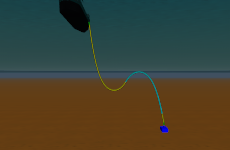
A07 Pliant Wave Riser.sim (2.7 MB)

A pliant wave formation is a lazy wave with the addition of a tether restraining the touchdown point.

A07 Pliant Wave Riser.sim

A08 Pliant S Riser.sim (3.2 MB)

A pliant S formation is a lazy S with the addition of a tether restraining the touchdown point.

A08 Pliant S Riser.sim
Back to top

Alternatively you can download these 8 examples in a single zip file (17.4 MB)

B - Riser Systems - more complex

B01 Jumper to High Tower.sim (6.7 MB)

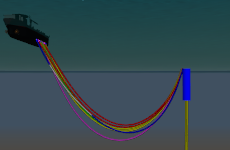
This example has jumpers connected from a vessel to the top of a high tower, i.e. the tower top is close to the surface. The lines then descend to the seabed as rigid structures within the tower. An installation of this type can be found in the Girassol field.

As this is a deep water system, the tower top will flex under the weather and jumper loads. It has therefore been modelled as a very stiff line with one end fixed, i.e. a vertical cantilever. As the motion may be dependent on loads from the jumpers as well as the waves and current, all attached jumpers need to be modelled.

If the tower motions are known, it can be modelled as a vessel with the motions specified. This would mean that individual jumpers could be analysed, if required, as they would have no effect on the modelled motion of the tower.

B01 Jumper to High Tower.sim

B02 Releasable Turret.sim (13.3 MB)

This model represents an FPSO system with a releasable turret. The simulation shows the turret buoy disconnecting and the FPSO moving off station. An installation of this type can be found in the Terra Nova field.

Vessel travel and link disconnection are discussed.

B02 Releasable Turret.sim

B03 Detailed Pliant Wave.sim (1.1 MB)

This pliant wave model has more detail in the tether and touchdown is on the edge of a ridge, the vessel being in deeper water. The ridge top and side profiles are included in the model. An installation of this type can be found in the Buffalo field.

The model includes tether details and a profiled seabed.

B03 Detailed Pliant Wave.sim

B04 Full Field Layout.sim (18.7 MB)

The model contains 2 ships, 22 lines and various other items, and is modelled in a random sea. In practice, it would be unusual to model the whole of a system at once, but this example serves to demonstrate that OrcaFlex can readily handle very complicated systems. OrcaFlex imposes no limits on the number of lines, ships, buoys etc. which can be modelled.

B04 Full Field Layout.sim
Back to top

Alternatively you can download these 4 examples in a single zip file (31.2 MB)

C - Steel Catenary Risers

C01 Catenary SCR.sim (13.7 MB)

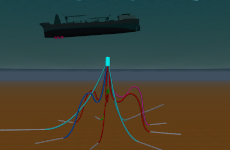
This example has a SPAR buoy with three steel pipes (SCRs) descending from it in a catenary formation.

User specified units are used.

C01 Catenary SCR.sim

C02 Lazy Wave SCR.sim (3.0 MB)

Just as for flexible risers, steel risers can be supported in a lazy wave formation. The line is given support at about midwater by a series of buoyancy modules along its length. 'Lazy' means that the bottom part of the riser lies on the seabed. 'Wave' describes the line shape as a result of the buoyancy modules.

Stress diameters are used for the buoyed length.

C02 Lazy Wave SCR.sim

C03 Steep SCR.sim (594 KB)

As with flexible risers, a steel riser steep wave formation has support provided at about midwater by distributed buoyancy modules and has a vertical connection at the seabed. 'Steep' means that the riser centreline is near vertical at the lowest end while 'Wave' describes the line shape as a result of the buoyancy modules.

The model shows a sloped seabed and a flex joint.

C03 Steep SCR.sim
Back to top

Alternatively you can download these 3 examples in a single zip file (14.6 MB)

D - Tensioned Risers, TLPs and SPARs

D01 Drilling Riser.sim (1.7 MB)

A tensioned drilling riser descends from a platform to the seabed. The model demonstrates the use of slip joints, tensioners and moonpool clearances.

D01 Drilling Riser.sim

D02 Workover riser.sim (4.4 MB)

A workover riser is deployed from semi-submersible drilling vessel. The lubricator assembly is suspended in the drilling derrick and the riser hangs below it, with much of its weight supported by a pair of tensioners hung off the drill floor. Clearance is tight where the riser passes through the drill floor, and this area is an important point of interest in the analysis.

D02 Workover riser.sim

D03 SPAR.sim (2.2 MB)

A riser descends from the SPAR to the seabed via a guide down the middle of the spar. A constant tension device is at the top of the riser.

The model demonstrates the use of riser guides and hydrodynamic shielding within the moonpool.

D03 SPAR.sim

D04 TLP.sim (1.8 MB)

A small TLP is modelled with its moorings and an attached umbilical. This uses a Spar buoy option rather than RAO data.

D04 TLP.sim
Back to top

Alternatively you can download these 4 examples in a single zip file (6.8 MB)

E - Mooring Systems

E01 Slow drift - no RAOs.sim (4.5 MB)

The ship is moored using a three-leg branched moorings system. The simulation shows slow drift motion only in wind, waves and current from different directions. Wind is defined by an API spectrum, waves by a JONSWAP spectrum. (Other options are available.)

Example E02 shows the same simulation with first order wave response also included.

E01 Slow drift - no RAOs.sim

E02 Slow drift - with RAOs.sim (8.9 MB)

The ship is moored using a three-leg branched moorings sytem. The simulation shows both slow drift and first order wave motion in wind, waves and current from different directions. Wind is defined by an API spectrum, waves by a JONSWAP spectrum. (Other options are available.) First order wave motions are applied using RAOs.

Example E01 shows the same simulation with first order wave response omitted.

E02 Slow drift - with RAOs.sim

E03 Released Mooring Buoy.sim (2.2 MB)

This example shows how to model the effect on a mooring line of one of its attached buoys breaking free.

In particular, we are interested in the proximity of the mooring line to a static pipeline lying on the seabed. In this file we examine the failure condition of one buoy breaking free. The dynamic response of the line to the changed loads following the buoy failure is modelled, reporting the dynamically changing clearances with the pipeline.

E03 Released Mooring Buoy.sim
Back to top

Alternatively you can download these 3 examples in a single zip file (12.1 MB)

F - Buoy Systems

F01 CALM Buoy.sim (1.9 MB)

A CALM buoy is held in place by six equally spaced mooring lines. It is attached to the vessel by a hawser and a transfer hose.

The CALM buoy is modelled using a Spar Buoy.

F01 CALM Buoy.sim

F02 Chinese Lantern.sim (4.0 MB)

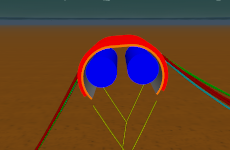
This system consists of risers descending from the underside of a buoy to its base on the seabed in a chinese lantern configuration. As they are fixed at the buoy and its base, there must be sufficient length to prevent the risers going taut due to buoy motions. This excess length is accommodated by encouraging the risers to bulge outwards beneath the buoy, hence the name.

This example demonstrates static solution using splines.

F02 Chinese Lantern.sim

F03 Metocean Buoy in Deep Water.sim (3.0 MB)

The example shows a buoy positioned at the sea surface in deep water. It is held in place by a long mooring line anchored at the seabed. A regular wave train has been applied.

F03 Metocean Buoy in Deep Water.sim
Back to top

Alternatively you can download these 3 examples in a single zip file (7.0 MB)

G - Installation

G01 Pipelay.sim (1.8 MB)

Pipe lay over the stern in 120m water depth from a 100m long reel barge. The support rollers are spaced out along a rigid stinger projecting from the stern, and the lay operation is being modelled in head seas and current. The model was originally prepared in the Orcina pipelay analysis program OrcaLay and exported as an OrcaFlex data file.

G01 Pipelay.sim

G02 Lay on tower.sim (1.4 MB)

This is an example of installing a riser over a subsea tower in 300m of water. The riser is being paid out from the moonpool of the installation vessel, and is supported by an auxiliary winch at the stern of the ship. There is a clamp about 10m above the attachment point of the winch, which has to be placed in the centre of the support tower.

G02 Lay on tower.sim

G03 Crane Lower.sim (1.6 MB)

This is an example of modelling the lowering of a template structure from the sea surface to the seabed using two cranes. In practice it would be more usual to look at a series of "snapshots" rather than the complete lowering operation.

It covers winches, seabed interaction and random wave trains.

G03 Crane Lower.sim

G04 Pipe Davit Lift.sim (1.6 MB)

The free end of a steel pipe is lifted from the seabed by davits to bring it alongside a workboat. The lift is modelled dynamically in calm water.

G04 Pipe Davit Lift.sim

G05 Midline pull-up.sim (1.1 MB)

A long line is laid on the seabed. The middle is then pulled up a short distance to allow maintenance or to position the line in a plough.

G05 Midline pull-up.sim

G06 Seabed pull-in.sim (4.0 MB)

A line is pulled in to a wellhead funnel by a winch. A gateway ahead of the funnel controls the pipe entry. Line-line contact is demonstrated.

G06 Seabed pull-in.sim

G07 Anchor-last Deployment.sim (634 KB)

This model shows a method commonly adopted for the deployment of a deep water oceanographic mooring. The mooring is streamed out behind a moving vessel, with the top end buoy as the first object in the water, furthest from the vessel. When the whole length of the mooring has been deployed, the anchor is tied off at the vessel stern, and the vessel proceeds to the correct mooring position. Without stopping the vessel, the anchor is cut free, and the whole mooring free-falls until the anchor hits the seabed.

The simulation is used to determine the final position of the anchor relative to the vessel's position when the anchor ties are cut. It is also used to determine the tensions in the line.

G07 Anchor-last Deployment.sim

G08 Lower with Bend Limiter.sim (626 KB)

Deploying a seabed module with an attached umbilical. The termination is protected with a bend limiter.

G08 Lower with Bend Limiter.sim
Back to top

Alternatively you can download these 8 examples in a single zip file (7.1 MB)

H - Offloading Systems

H01 Stowed Line.sim (5.2 MB)

A floating hose, which is attached to the stern of an FSU (Floating Storage Unit), is stowed by curling it around and attaching the free end to the vessel side. Interaction with the vessel sides needs to be considered.

Interaction between lines and solids is demonstrated.

H01 Stowed Line.sim

H02 Floating Line.sim (3.5 MB)

The same hose as in H01 is now modelled trailing free from the FSU stern. During the analysis, the protective chain at the FSU breaks.

This example demonstrates floating hose statics and tether release.

H02 Floating Line.sim

H03 Jacket to Semisub.sim (1.4 MB)

A cable catenary is suspended between a semi-submersible rig and fixed jacket. It is analysed in a random sea.

This example demonstrates line on line contact and compares contact force and contact impulse as methods for assessing impact.

H03 Jacket to Semisub.sim
Back to top

Alternatively you can download these 3 examples in a single zip file (7.1 MB)

I - Towed Arrays

I01 Streamer Array.sim (1.7 MB)

This is an example of a seismic streamer model. The model represents the Port half of the system only i.e. two hydrophone streamers plus one air gun towed from a ship. The model includes wings on buoys.

I01 Streamer Array.sim

I02 Deployment with Sub.sim (6.4 MB)

A submarine tows a sensor array. It releases components in turn to position them on the seabed. Towed fish and releasing tethers are demonstrated.

I02 Deployment with Sub.sim
Back to top

K - Line-on-line Contact

K01 Line on line impact.sim (9.7 MB)

OrcaFlex allows you to prevent lines passing through each other during dynamic analysis. When the option is selected on both lines it generates a resistive force when one line contacts the other. This routine also takes account of line outer diameters when assessing contact.

In this example a line free at one end is swung to hit a second held at both ends in a curve.

K01 Line on line impact.sim

K02 Line on line slide.sim (798 KB)

The line clashing routine can be used to model one line sliding over another. However remember that friction is not included and this will only occur in dynamics. A fun example of this is given below.

A boy scout slides down an aerial ropeway by holding onto the ends of a short rope wrapped over it. He then flies off the end to hit the ground.

Disclaimer: no real boy scouts were injured in the making of this example!

K02 Line on line slide.sim
Back to top

M - VIV

M01 Vortex Tracking.sim (8.8 MB)

This example demonstrates the Vortex Tracking VIV model applied to a fixed cylinder and a spring mounted cylinder in steady flow.

M01 Vortex Tracking.sim

M02 Drilling riser.sim (21.2 MB)

Drilling riser in sheared and rotating current profile. Uses the Iwan & Blevins wake oscillator model.

M02 Drilling riser.sim

M03 Catenary cable.sim (5.7 MB)

VIV of a power cable. The cable is installed inside a J-tube, but the bottom end runs out in a catenary to the seabed. The analysis is concerned with possible VIV of the exposed section.

The model represents the exposed section only, including a short bend stiffener at the J-tube exit. The seabed end is treated as pinned. A uniform current is assumed to run normal to the plane of the catenary.

M03 Catenary cable.sim
Back to top

Alternatively you can download these 3 examples in a single zip file (31.8 MB)


OrcaFlex  |  Applications  |  Features  |  Screenshots  |  Demo  |  Examples  |  Documentation  |  Validation  |  Hardware Requirements